Hbada Ergonomic Mesh Chair Footrest or Hbada P2 Ergonomic Chair? Which Hbada Model to Buy
As an Amazon Associate we earn from qualifying purchases. Links on this page are affiliate links.
When you compare the hbada p5 ergonomic office chair vs p2 ergonomic office chair, you find two mesh-backed options with similar core support systems. Both models feature 3D adjustable lumbar support and 360-degree 3D armrests to help maintain proper posture during long work sessions. The main difference lies in their additional features and dimensions. The P5 includes a retractable footrest and a 2D headrest, while the P2 offers a more advanced 3D headrest and lacks the footrest. Your choice depends on whether you prioritize leg support or head adjustability.
Key differences
| Aspect | Hbada Ergonomic Mesh Chair with Footrest | Hbada P2 Ergonomic Chair |
|---|---|---|
| Headrest Type | 2D | 3D |
| Footrest | Included | Not listed |
| Seat Width | 10.9 inches | 13 inches |
| Seat Depth | 10.9 inches | 29.3 inches |
| Seat Height | 19.5 inches | 20.9 inches |
| Weight | 44 pounds | 42.3 pounds |
Which one should you choose?
Choose Hbada Ergonomic Mesh Chair with Footrest if
- You want a footrest for occasional leg elevation during breaks.
- You prefer a more compact seat footprint for smaller desks.
- You need a headrest with vertical and horizontal adjustments.
Choose Hbada P2 Ergonomic Chair if
- You need full 3D headrest adjustability for precise neck support.
- You have a wider body type requiring a 13-inch seat width.
- You prefer a deeper seat cushion for longer thigh support.
Verdict: Choose the P5 if you value the convenience of a footrest and a narrower seat design. The P2 is better if you require full 3D headrest movement and a wider, deeper seating surface. Both chairs provide similar lumbar and armrest support for daily use.
P5 vs P2 Key Differences
Footrest inclusion
The Hbada P5 includes a dedicated footrest, allowing you to elevate your legs and reduce pressure on your lower back during breaks. This feature is listed in its attributes and mentioned in the features section. The Hbada P2 does not list a footrest in its attributes or features. If you frequently need to recline or rest your legs, the P5 provides this utility. The P2 focuses solely on the seat and back support. For users who value leg elevation as part of their ergonomic setup, the P5 offers a clear advantage. The P2 leaves this to external accessories.
Headrest adjustability
Headrest adjustability differs between the two models. The Hbada P2 features a 3D headrest, which typically allows adjustment in height, depth, and angle to support your neck and head. The Hbada P5 is listed with a 2D headrest in its key specs. A 3D headrest generally offers more precise positioning for various body types and sitting angles. If you rely on head support to relieve neck strain, the P2 provides superior flexibility. The P5’s 2D mechanism may limit fine-tuning. For users with specific neck support needs, the P2’s 3D adjustability is the stronger choice. The P5 offers basic support.
Seat cushion design
Both chairs use breathable mesh for the back, but the seat cushion design varies slightly in description. The Hbada P5 specifies a cushion using premium elastic material with a micro-perforated design to resist flattening and manage heat. The Hbada P2 also uses a high-quality elastic seat cushion with a micro-perforated design for long-hour comfort. Both aim to prevent sweating and maintain shape. The P5 explicitly mentions skin-friendly armrest material, while the P2 focuses on the entire mesh back. Since both offer similar elastic and perforated seat features, there is no significant difference in seat comfort specs. Both provide comparable support for extended sitting.
Weight and size
Physical dimensions and weight affect stability and space requirements. The Hbada P5 weighs 44 pounds and has a width of 10.9 inches. The Hbada P2 is lighter at 42.3 pounds and has a width of 13 inches. The P2 is slightly wider, which may offer more lateral stability or comfort for broader users. The P5 is slightly heavier, potentially indicating a sturdier base or frame. The P2 is more compact in height at 19.5 inches compared to the P5’s 20.9 inches. For users with limited floor space, the P2’s narrower footprint might be preferable. The weight difference is minimal, but the width difference is notable.
Lumbar support system
Both chairs feature 3D adjustable lumbar support, which adjusts in height, depth, and width. This system is designed to move with your body and maintain spinal alignment. The data states both are suitable for users between 5'4" and 6'2". The P5 mentions a dual-back design, while the P2 also references a dual-back design. Since both offer identical 3D lumbar adjustability and similar back construction, the support mechanism is effectively the same. Neither model has a clear advantage in lumbar specs. Both provide customizable support for the lower back. Users seeking specific lumbar customization will find equivalent options in either chair. The core ergonomic support is matched.
Choose the right Hbada chair for you
Users needing leg elevation support
You should pick the P5 if you require a built-in footrest. This feature allows you to elevate your legs, which helps reduce lower back pressure during breaks. The mesh back and 3D lumbar support still provide spinal alignment, making it a practical choice for extended rest periods without leaving your seat.
Users wanting full head support
The P2 model includes a 3D headrest, offering adjustable support for your neck and head. This is ideal if you need to recline or rest your head during work. Combined with the 3D lumbar support and 3D armrests, it provides comprehensive upper body alignment that the P5 lacks in this specific area.
Users prioritizing lighter weight
If you need to move your chair frequently, the P2 is lighter at 42.3 pounds compared to the P5's 44 pounds. It also has a wider seat width of 13 inches. These specs make it slightly more manageable to reposition while still offering the same 3D adjustable armrests and breathable mesh comfort.
The products compared

Hbada Ergonomic Mesh Chair with Footrest
Best for: users needing 3D lumbar support and a footrest
- Upholstery Material
- Mesh
- Lumbar Support
- 3D
- Armrest Adjustability
- 360° 3D
- Headrest Type
- 2D
- Features
- Lumbar Support, Footrest, Headrest
- Color
- Black
View on Amazon: Hbada Ergonomic Mesh Chair with Footrest Affiliate link
The Hbada P5 features a breathable mesh back with 3D adjustable lumbar support that moves in height, depth, and width. It includes 360-degree 3D armrests and a built-in footrest for leg support. The seat uses high-resilience elastic material with micro-perforations. This model suits users between 5'4" and 6'2" who want customizable spinal alignment and a break-friendly design for long work sessions.
Pros
- 3D adjustable lumbar support for height, depth, and width customization
- 360-degree 3D adjustable armrests with 7.5 cm height and 4.2 cm forward/backward movement
- Built-in footrest for reclined relaxation
- Breathable mesh upholstery with micro-perforated seat cushion
Cons
- 2D headrest offers limited vertical and tilt adjustment compared to 3D options
- Heavier build at 44 pounds
- No mention of advanced tilt tension controls in specifications
Good fit if
- You need adjustable lumbar support to maintain proper spinal alignment
- You want a footrest for occasional leg elevation during breaks
- You are between 5'4" and 6'2" tall
Skip if
- You require a fully adjustable 3D headrest for neck support
- You prefer a lightweight chair under 40 pounds
- You do not need a footrest feature
Verdict: Hbada P5 Mesh Chair with Footrest is a solid choice for taller users who prioritize customizable lumbar support and leg rest functionality over advanced headrest adjustments.
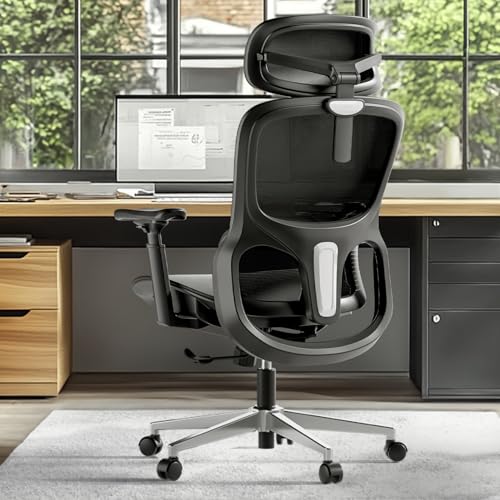
Hbada P2 Ergonomic Chair
Best for: Users under 6'2" needing detailed lumbar and arm adjustments
- Upholstery Material
- Mesh
- Lumbar Support
- 3D adjustable
- Armrest Adjustability
- 3D
- Headrest Type
- 3D
- Features
- Lumbar Support, Headrest
- Color
- Black
View on Amazon: Hbada P2 Ergonomic Chair Affiliate link
The Hbada P2 is a mesh office chair built for posture support. It features 3D adjustable lumbar support and 3D armrests that move in height, depth, and rotation. The 3D headrest adds neck coverage. You get a breathable mesh back and a high-resilience seat cushion. It suits users between 5'4" and 6'2" who need customizable alignment for long workdays.
Pros
- 3D adjustable lumbar support moves in height, depth, and width
- 3D armrests offer height, forward/backward, and 360° rotation adjustments
- 3D headrest provides adjustable neck support
- Breathable mesh back and micro-perforated seat cushion
Cons
- No built-in footrest included in the specifications
- Seat cushion is not made of full mesh material
- Maximum user height listed is 6'2"
Good fit if
- You are between 5'4" and 6'2" tall
- You need precise lumbar alignment adjustments
- You want a breathable mesh back for long hours
Skip if
- You are taller than 6'2"
- You require a built-in retractable footrest
- You prefer a full mesh seat design
Verdict: Hbada P2 Mesh Chair with 3D Adjustability is a strong option for users under 6'2" who need detailed spinal and arm alignment. It offers extensive adjustability for posture but lacks a footrest.
Specifications side by side
| Spec | Hbada Ergonomic Mesh Chair with Footrest | Hbada P2 Ergonomic Chair |
|---|---|---|
| Upholstery Material | Mesh | Mesh |
| Lumbar Support | 3D | 3D adjustable |
| Armrest Adjustability | 360° 3D | 3D |
| Headrest Type | 2D | 3D |
| Features | Lumbar Support, Footrest, Headrest | Lumbar Support, Headrest |
| Material | Mesh | Mesh |
| Color | Black | Black |
| Dimensions | 10.9 × 10.9 × 19.5 inches | 29.3 × 13 × 20.9 inches |
| Weight | 44 pounds | 42.3 pounds |
| Size | 27.56 x 27.56 x 49.41 inches | 12.99 x 29.33 x 20.86 inches |
| Model | P5 | P2 |
Frequently asked questions
Which Hbada chair is better for tall users?
The Hbada P5 is the better choice for taller individuals. Its verdict notes it is a solid option for taller users who prioritize customizable lumbar support. The P2 is recommended for users under 6'2". If you are taller, the P5's design and included footrest offer better support for your frame.
Does the Hbada P2 have a footrest?
No, the Hbada P2 does not include a footrest. The product data states it lacks this feature. You should choose the Hbada P5 if you need a built-in footrest to elevate your legs. The P2 focuses on detailed spinal and arm alignment instead.
What is the weight difference between the two chairs?
The Hbada P5 weighs 44 pounds, while the Hbada P2 weighs 42.3 pounds. The P5 is slightly heavier by 1.7 pounds. This difference is minor, but the P5 includes a footrest mechanism which may contribute to its extra mass compared to the P2 model.
Can I adjust the armrests on both chairs?
Yes, both chairs feature 3D adjustable armrests. The comparison section confirms both models have 360-degree 3D armrests to help maintain proper posture. This allows you to customize the height, depth, and angle of the armrests on either the P5 or the P2 to suit your desk setup.
Is the lumbar support adjustable on the P5?
Yes, the Hbada P5 features 3D adjustable lumbar support. This is listed in its attributes and mentioned in the comparison section. It allows you to customize the support for your lower back. The P2 also offers 3D lumbar support, but the P5 is noted for its customizable nature.
Which chair is better for short breaks?
The Hbada P5 is better for short breaks because it includes a footrest. This feature allows you to elevate your legs and reduce pressure on your lower back. The P2 lacks a footrest, so you cannot use it for the same type of leg elevation during rest periods.
Does the P2 have a headrest?
Yes, the Hbada P2 includes a headrest. This is listed in its attributes and features section. The P5 also has a headrest. However, the P5 is preferred for users who prioritize leg rest functionality over advanced headrest adjustments, according to the product verdicts.
What is the seat depth of the P2?
The Hbada P2 has a seat depth of 29.3 inches. This is listed as the length in its specs. The P5 has a length of 10.9 inches, which likely refers to the footrest or a different dimension. The P2 offers more extensive adjustability for posture, fitting users under 6'2".